
Fairfield County Projected Versus Actual Release
Connecticut uses several date labels, and each answers a different question. The CT DOC field inventory includes Minimum Release Date, Maximum Release Date, and Estimated Release Date. The Estimated Release Date is the closest official field to what people often call a projected release date. A Maximum Release Date is an outer term-related date when applicable. A Special Parole End Date marks the end of post-release supervision, not the date the person first leaves prison.
A sentenced person has a sentence calculation. It begins with the court judgment and may account for the sentencing date, total effective sentence, controlling offense, jail credit, a mandatory minimum, earned credit, and parole rules. A person held before trial does not yet have that type of sentence calculation. Release from Bridgeport Correctional Center may instead result from bond, a promise to appear, dismissal, court discharge, transfer, or a new commitment. In that setting, the Judicial Branch docket is often more useful than an estimated date field.
Actual release can also differ from sentence completion. Parole, special parole, transitional supervision, or another community placement may move a person out of a facility while legal control continues. A discharge means the relevant sentence or supervision term has ended. Use that word only when an official record supports it.
Search Fairfield County Inmate Release Dates
The official starting point for a state case is the CT DOC Inmate Search landing page, which connects to the public inmate information database. Search fields include CT DOC inmate number, last name, first name, and date of birth. CT DOC recommends a focused search. An inmate number or the first letters of a last name can work better than filling every box. Match a result by several identifiers before reading its date fields.
- Determine whether the person is in state, municipal, or federal custody. CT DOC dates do not govern an FCI Danbury sentence.
- Search the CT DOC database by inmate number when available. If not, start with the last name.
- Confirm the date of birth, status, controlling offense, and current location. A same-name result is not enough.
- Read Maximum Release Date and Estimated Release Date as separate fields. Check Special Parole End Date only for the supervision period.
- Review the detainer field. Another agency hold can stop a community release even when a sentence date arrives.
- Open the Judicial Branch criminal lookup to confirm the sentence, disposition, bond event, or later court change.
- Use BOPP records if parole has been considered. A voted-to-parole date is an on-or-after date.
- Request written information from CT DOC Public Information when the online sources conflict or omit the needed fact.
CT DOC says its public information updates daily and can change quickly. It excludes Youthful Offender records and people held on behalf of ICE. A person released by a municipal police department before DOC intake may never appear as a current DOC inmate. No result, by itself, cannot prove release.
The complete named-person workflow is available through the Fairfield County released-inmate search. It separates the state DOC, court, federal, and municipal paths.
Fairfield County Sentence Date Factors
The court judgment sets the base. CT DOC then calculates the correctional dates under the sentence and applicable law. Presentence confinement credit recognizes qualifying time already spent in custody before the imposed term begins. Conn. Gen. Stat. § 18-98d governs that credit for time in a community correctional center or correctional institution. In specified circumstances, it also covers time in a police station or courthouse lockup when bail was unavailable or denied and the credit is requested at sentencing.
Concurrent and consecutive sentences can change the math. Concurrent terms run together to the extent the judgment allows. Consecutive terms run one after another. Mandatory minimum terms also limit how far some credit can move a date. A docket may show the sentence, but CT DOC remains responsible for its custody calculation. For that reason, subtracting days from a sentence without the official record can produce a false result.
| Factor | Possible effect on the date | Best source |
|---|---|---|
| Presentence confinement | Qualifying prior custody can reduce time left to serve | Court record and CT DOC calculation |
| Risk Reduction Earned Credit | Eligible people may earn a discretionary sentence reduction | CT DOC and § 18-98e |
| Mandatory minimum | Can prevent credit from reducing a required term | Judgment and governing statute |
| Detainer | May lead to transfer or continued custody rather than community release | CT DOC field and holding agency |
| Parole decision | Can create an on-or-after release opportunity before maximum expiration | BOPP decision and CT DOC |
| New court order | Modification, pardon, or other action can alter the calculation | Judicial Branch docket |
| Discipline or program status | May reduce or remove discretionary earned credit | CT DOC record |
A federal release date follows federal calculations. BOP warns that First Step Act recalculations can change dates in its Inmate Locator. CT DOC credit rules should never be applied to FCI Danbury.
Fairfield County Risk Reduction Credit
Connecticut's Risk Reduction Earned Credit program is based on Conn. Gen. Stat. § 18-98e. Eligible sentenced people committed for qualifying crimes may earn up to five days per month at the Commissioner's discretion. The statute ties credit to an offender accountability plan, participation in eligible programs and activities, and compliance with institutional rules. Good conduct alone does not create an automatic right to credit. Listed offenses and other statutory limits can make a person ineligible.
The CT DOC Risk Reduction Earned Credit page describes the operating grid adopted in 2016. Level 1 and Community Supervision can earn five days per month. Levels 2 and 3 can earn four. Level 4 can earn three. CT DOC describes Level 5 as the highest risk level. Credit may be lost for misconduct, refusal to follow a program or rules, or other good cause, and it cannot cut a mandatory minimum below the required term.
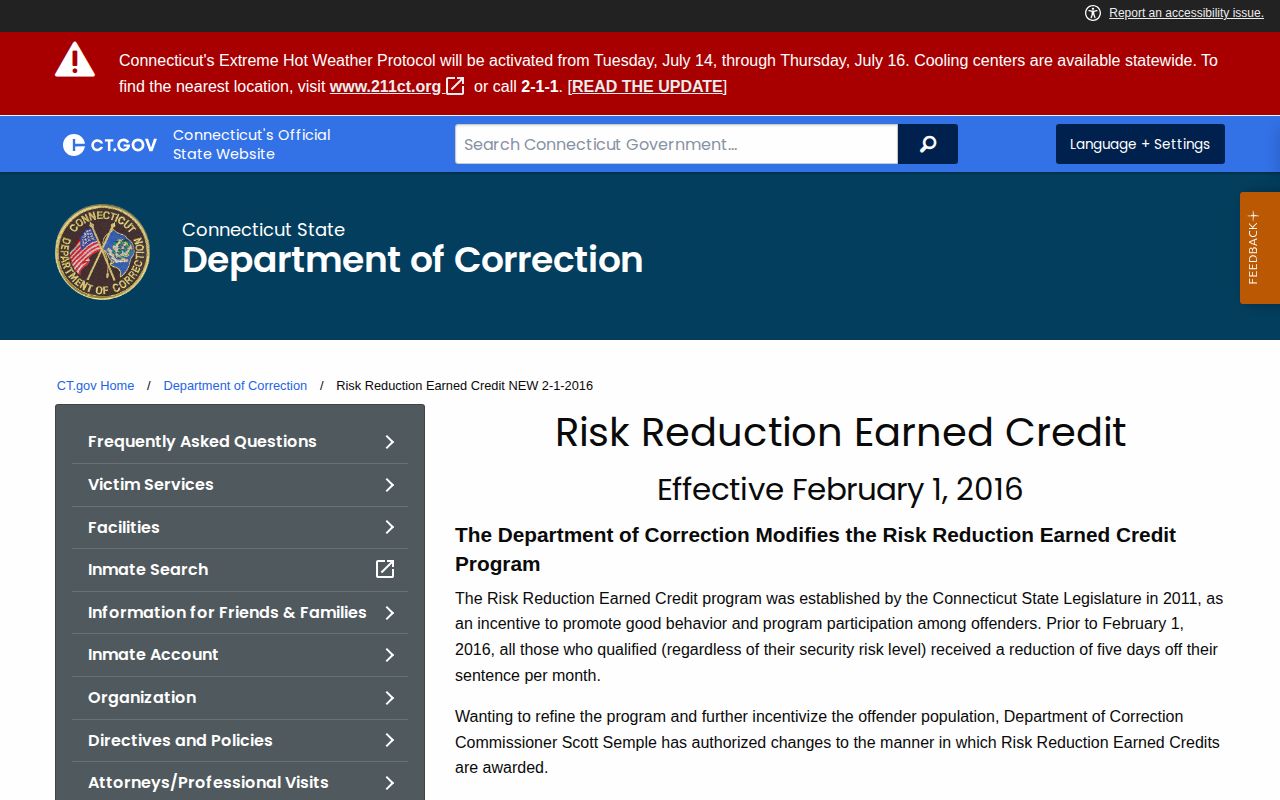
The official grid shows why an Estimated Release Date can move as classification, participation, and awarded credit change.
Fairfield County 85 Percent Rule
Connecticut's key release-date quirk is that sentence reduction and parole eligibility do not always move together. BOPP states that people serving a definite total effective sentence of at least two years and one day are generally eligible for discretionary parole review after 50 percent, less applicable jail or risk reduction credit. For an offense involving the use, attempted use, or threatened use of physical force, the general eligibility point is 85 percent less jail credit.
For offenses committed on or after July 1, 2013, BOPP says Risk Reduction Earned Credit does not reduce the parole eligibility date for people in the 85 percent group. RREC may still have a role in sentence administration when the law allows, but it cannot be used to move that protected eligibility date. This is why a reader should not assume that a change in the CT DOC Estimated Release Date creates an equal change in parole review.
The BOPP parole eligibility source sets out the general 50 percent and 85 percent rules.
The source also distinguishes eligibility from suitability. The Board may deny parole even after the eligibility point arrives.
Fairfield County Parole Date Changes
BOPP can grant parole with conditions and set a voted-to-parole date. The agency describes that date as on or after, not as a fixed release promise. As it approaches, Parole and Community Services contacts the person and sponsor to arrange transportation or pickup. Release planning, approved conditions, a valid sponsor, and any detainer must still be resolved.
The Board may also deny parole, continue a case, or set a later hearing. After a grant, new charges, disciplinary conduct, failed programming, or new case information can lead to a rescission, modification, or offset. Rescission means an earlier grant is withdrawn or changed before release. The Revocations and Rescissions Unit handles those proceedings and also hears alleged violations after parole or special parole begins.
The BOPP Parole FAQ explains these decision outcomes and the release coordination process.
Read a Board decision beside the latest CT DOC status. Either source alone may omit a later event.
Fairfield County Release Date Sources
The right record depends on where the person entered custody. Bridgeport Correctional Center holds both accused and sentenced people and serves courts across Fairfield County. Bond and court discharge can control a pretrial release. Garner Correctional Institution has both accused and sentenced populations but also serves a statewide mental health role. Its next status may be another facility, a treatment-linked plan, parole, community release, or discharge.
| Custody lane | Date source | What to verify |
|---|---|---|
| Bridgeport CC pretrial | Judicial Branch docket and CT DOC | Bond, court order, transfer, or commitment |
| Connecticut sentenced term | CT DOC date fields and court judgment | Estimated and Maximum Release Dates, credit, detainer |
| Parole or special parole | BOPP decision and CT DOC status | On-or-after date, conditions, Special Parole End Date |
| Municipal lockup | Arresting police records and court docket | Release before DOC commitment |
| FCI Danbury | BOP Inmate Locator | Federal Release Date and Location |
| Immigration custody | ICE locator | Current ICE or qualifying CBP custody |
CT DOC says people held on behalf of ICE do not appear in its public database. An immigration transfer can therefore explain why a state term appears complete while the person is not released into the community. A federal or immigration case must not be forced into Connecticut's sentence-credit rules.
Confirm Fairfield County Actual Release
Use CT SAVIN through VINELink for a pending custody-change alert. Connecticut provides separate registration lanes for Offenders and Offenders with Court Cases. Register in both when both DOC and Judicial Branch notices matter. A notification can report bond out, court discharge, community placement, end of sentence, or return to custody, but it does not replace the detailed sentence and disposition records.
The Fairfield County VINELink Release Check explains that one-person notification route. For written state offender information, contact CT DOC Public Information at (860) 692-7780 or 24 Wolcott Hill Road, Wethersfield, CT 06109. The office is available from 8:00 a.m. to 4:30 p.m., Monday through Friday. Include full name, date of birth, inmate number, facility, approximate dates, and the exact date field or movement record needed.
Always identify what is being confirmed: a projected date, a parole eligibility date, an on-or-after parole date, physical release, or final discharge. Those events can occur months or years apart.